Green Silicon Carbide Micropowder: Functional Filler for Wear-Resistant & UV-Curable Coatings
UV-curable coatings feature fast curing speed, low VOC and high production efficiency, and are widely used in plastic housings, floor topcoats, optical protective coatings, inks, PTFE-modified coatings and other fields. Ordinary fillers such as calcium carbonate, talc and alumina are prone to scratches and rapid film wear under high-abrasion working conditions. As a high-performance inorganic functional filler, green silicon carbide micropowder, with its high hardness, chemical inertness and stable thermal conductivity, has become a preferred modified powder for high-end wear-resistant UV coatings and industrial anti-corrosion coatings.
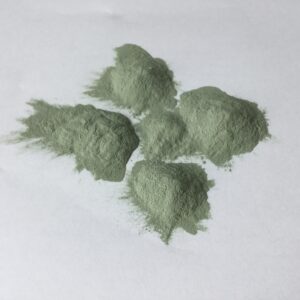
Zhengzhou Haixu Abrasives supplies green silicon carbide micropowder specially for coatings and inks. Purified by acid washing and precisely classified, it has low impurities and narrow particle size distribution. It is compatible with transparent clear coats, matte wear-resistant topcoats, fluorocarbon anti-corrosion coatings and non-stick coating formulas. COA test reports are available for each batch.
I. Core Performance Advantages of Green Silicon Carbide in UV Coatings
- Excellent wear and scratch resistance (core value) Green silicon carbide has a Mohs hardness of 9.3, considerably harder than conventional alumina fillers. Evenly dispersed in the UV resin system, it forms hard wear-resistant supporting points inside the cured coating to distribute friction load. A properly controlled addition of 5%–15% green silicon carbide micropowder can greatly improve the coating’s resistance to steel wool and hard-object scratching and extend its service life. It is suitable for UV topcoats on wood floors, automotive interiors and protective clear coats for electronic housings.
- Chemical corrosion resistance, aging resistance and anti-yellowing property Green silicon carbide boasts strong chemical stability, resisting acids, alkalis and solvents, and will not react with UV resins or photoinitiators. Once formed, the coating can withstand erosion from grease, cleaning agents and chemical media for enhanced anti-corrosion performance. It hardly turns yellow after long-term service, making it suitable for UV protective coatings for outdoor and chemical equipment.
- Thermal conduction to reduce curing defects
- Adjustable matte effect for diverse coating textures
- Low thermal expansion and dimensional stability It has a low thermal expansion coefficient.
II. Selection Guidelines for Different Coating Applications
- Transparent UV wear-resistant clear coats (optical lenses, radar radomes, high-end plastics): 3000# 4000
- UV topcoats for wood floors and furniture: 1000# 1500# 2000#
- Inks and ceramic protective coatings: Adopt narrow-distribution micropowder for good dispersion and low sedimentation tendency.