
Application Value of Green Silicon Carbide in Alloy Grinding Discs
With unique crystal properties, green silicon carbide (GC) is the preferred abrasive grain for resin-bonded and ceramic-bonded alloy grinding discs, specially developed for grinding hard-to-machine materials such as cemented carbide and tungsten carbide. Its core application values are as follows:
- Excellent self-sharpening property for lasting sharp cutting Green silicon carbide has moderate crystal brittleness. Under grinding force, new cutting edges keep forming continuously on particles, so it is not easy to passivate and slip. When made into alloy grinding discs, it maintains sharpness during long-time grinding of tungsten carbide and cemented carbide, delivering stable grinding efficiency and lowering the cost of frequent disc replacement. It outperforms fused alumina abrasives which tend to dull and slow down.
- Outstanding thermal conductivity to reduce workpiece burn and discoloration Cemented carbide has limited heat resistance. Concentrated grinding heat easily causes burning, decarburization and cracking. Green silicon carbide transfers heat away rapidly from the grinding zone and lowers local temperature rise. It protects alloy workpieces and reduces scrap rate, which is the key reason why green silicon carbide is prioritized for alloy grinding discs.
- Low iron and low impurity content to avoid workpiece contamination and rusting High-purity green silicon carbide is strictly controlled for iron impurities. It will not introduce iron elements onto the surface of cemented carbide and tungsten carbide during grinding, preventing rust spots and surface contamination. It is suitable for precision alloy workpiece grinding and meets processing requirements for precision moulds and alloy cutting tools.
- High hardness for machining high-hardness materials such as cemented carbide It has a Mohs hardness of 9.3, higher than white fused alumina and brown fused alumina. It can effectively cut and grind cemented carbide and tungsten carbide with high stock removal capacity, suitable for rough grinding, dressing and edge sharpening.
- Good compatibility with mainstream bonding systems for grinding discs Its regular particle morphology ensures good wettability with resin bond and ceramic bond. Finished grinding discs have stable structure and low grain shedding risk. A full range of grits including abrasive grains and micropowders are available. Different grits can be selected according to disc positioning (rough grinding disc / fine grinding disc) to flexibly adjust cutting force and surface finish.
- Uniform ground texture to reduce workload of subsequent finishing processes The cutting edges are evenly distributed. It produces uniform scratches without deep coarse marks on workpieces. The improved surface quality reduces the workload of subsequent lapping and polishing and raises the overall efficiency of the whole processing line.
- Main Chemical Indexes and Physical Properties of Green Silicon Carbide
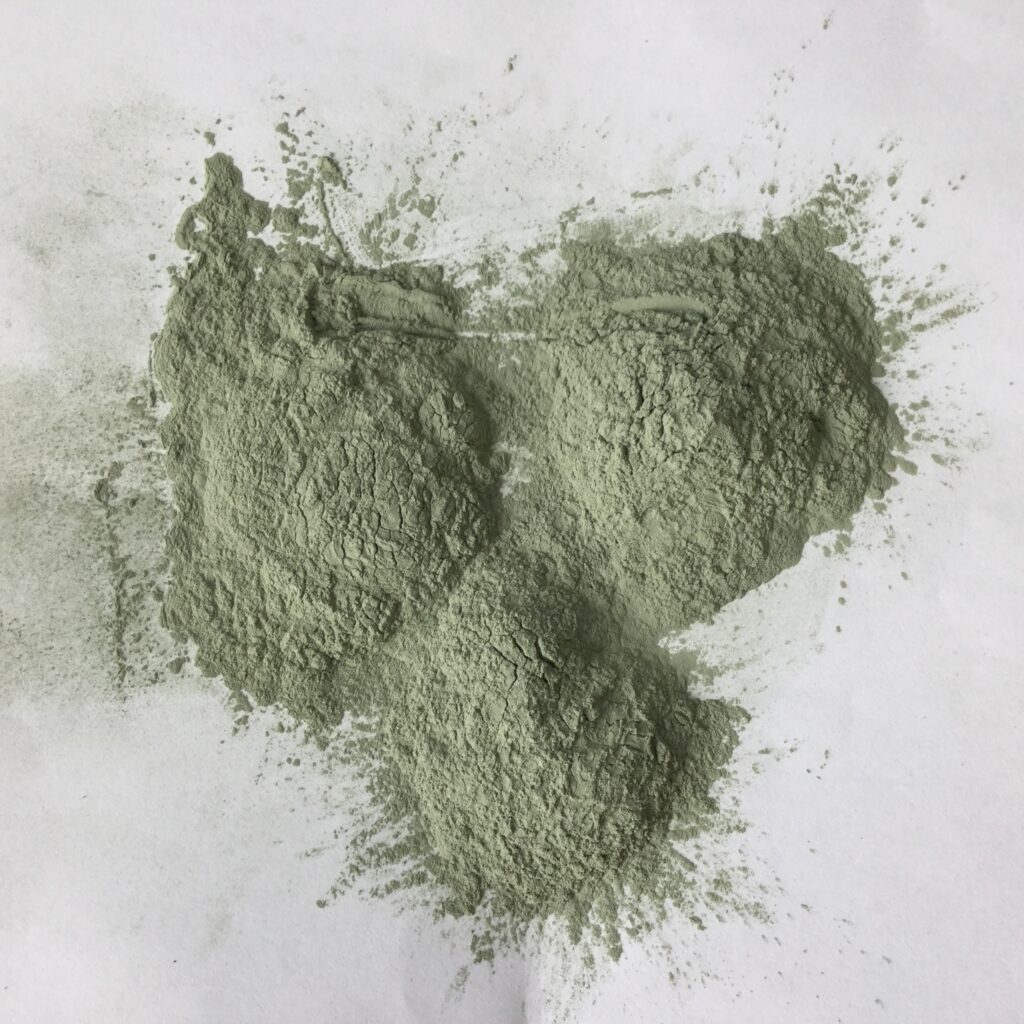
| Item | Specification |
|---|---|
| SiC | 98.5–99.5% |
| C.F | 0.1–0.2% |
| Fe₂O₃ | 0.05–0.1% |
| Color | Green |
| Crystal form | Hexagonal system |
| Specific gravity | 3.2 g/cm³ |
| Mohs hardness | 9.3 |
| Knoop hardness | 3100–3400 Kg/mm² |
| Crushing strength | 5800 kPa·cm⁻² |
| Melting point | 2730 ℃ |
| Thermal conductivity | (6.28–9.63) W·m⁻¹·K⁻¹ |
| Linear expansion coefficient | (4 – 4.5) × 10⁻⁶ K⁻¹ (0 – 1600 ℃) |
European Standard Grit: F230, F240, F280, F320, F360, F400, F500, F600, F800, F1000, F1200, F1500, F2000
Japanese Standard Grit: #240, #280, #320, #360, #400, #500, #600, #700, #800, #1000, #1200, #1500, #2000, #2500, #3000, #4000, #6000, #8000, #10000
W Series Micropowder: W63, W50, W40, W28, W20, W14, W10, W7, W5, W3.5, W2.5, W1.5, W1
European Standard Particle Size Distribution
表格
| Grit | D3(μm) | D50(μm) | D94(μm) |
|---|---|---|---|
| F230 | 82 | 53.0±3.0 | 34 |
| F240 | 70 | 44.5±2.0 | 28 |
| F280 | 59 | 36.5±1.5 | 22 |
| F320 | 49 | 29.2±1.5 | 16.5 |
| F360 | 40 | 22.8±1.5 | 12 |
| F400 | 32 | 17.3±1.0 | 8 |
| F500 | 25 | 12.8±1.0 | 5 |
| F600 | 19 | 9.3±1.0 | 3 |
| F800 | 14 | 6.5±1.0 | 2 |
| F1000 | 10 | 4.5±0.8 | 1 |
| F1200 | 7 | 3.0±0.5 | 1 |
| F1500 | 5 | 2.0±0.4 | 0.8 |
| F2000 | 3.5 | 1.2±0.3 | 0.5 |
Japanese Standard Particle Size Distribution
表格
| Grit | D0 (Max. Grain) | D3 (Coarse Grain) | D50 (Basic Grain) | D94 (Fine Grain) |
|---|---|---|---|---|
| 240# | ≤127 | ≤103 | 57±3.0 | ≥40 |
| 280# | ≤112 | ≤87 | 48±3.0 | ≥33 |
| 320# | ≤98 | ≤74 | 40±2.5 | ≥27 |
| 360# | ≤86 | ≤66 | 35±2.0 | ≥23 |
| 400# | ≤75 | ≤58 | 30±2.0 | ≥20 |
| 500# | ≤63 | ≤50 | 25±2.0 | ≥16 |
| 600# | ≤53 | ≤41 | 20±1.5 | ≥13 |
| 700# | ≤45 | ≤37 | 17±1.5 | ≥11 |
| 800# | ≤38 | ≤31 | 14±1.0 | ≥9 |
| 1000# | ≤32 | ≤27 | 11.5±1.0 | ≥7 |
| 1200# | ≤27 | ≤23 | 9.5±0.8 | ≥5.5 |
| 1500# | ≤23 | ≤20 | 8±0.6 | ≥4.5 |
| 2000# | ≤19 | ≤17 | 6.7±0.6 | ≥4.0 |