News

Functions of Black Silicon Carbide Added in Nano‑Insulation Boards

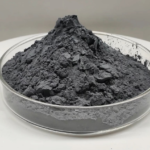
Black silicon carbide is mainly added into nano‑insulation boards as an infrared opacifier. It addresses the infrared radiation penetration issue of the silica‑based matrix at high temperatures, while additionally improving the high‑temperature resistance and mechanical properties of boards. Core Function: Block High‑Temperature Infrared Radiation The nano‑porous silica matrix is semi‑transparent to mid‑infrared thermal radiation. As

Read More »

Green Silicon Carbide GC Main Grit Standards

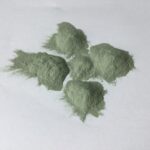
Green Silicon Carbide GC Main Grit Standards Grade designation for green silicon carbide: GC; grits fall into two major categories: grit grains (coarse grit) and micro‑powders (fine micro‑powders) 1. European FEPA Standard (ISO 8486, most common for Europe, Middle‑East, Southeast‑Asia foreign trade) FEPA has two sets: F‑grit / P‑grit. Same grit designations but different particle‑size

Read More »

β‑Silicon Carbide (β‑SiC) Applications in the Semiconductor Industry

β‑Silicon Carbide (β‑SiC) Applications in the Semiconductor Industry β‑SiC, also known as 3C‑SiC, features a cubic zinc‑blende crystal structure and is a metastable phase. It differs from the commercially dominant 4H‑SiC (α‑phase hexagonal) for power devices. It has a bandgap of approx. 2.36 eV, high electron mobility, supports hetero‑epitaxy on silicon wafers, and delivers excellent high‑temperature

Read More »

What types of glass are polished with green silicon carbide?

Green silicon carbide is mainly applied for grinding, rough grinding and lapping processes, rather than final bright polishing. Cerium oxide is mostly adopted for final mirror‑finish polishing. Green silicon carbide removes material allowance by sharp cutting action. It is suitable for glass with relatively high hardness. Low iron impurity content is mandatory to avoid rust

Read More »

Beta‑Silicon Carbide (β‑SiC) Applications in Advanced Sintered Ceramics ?

β‑SiC (3C‑SiC cubic silicon carbide) powder possesses far superior sintering activity compared with α‑SiC (hexagonal green/black silicon carbide). It enables densification via lower‑temperature pressure‑less sintering, hot pressing and hot isostatic pressing. Its cubic crystal delivers isotropic thermal‑mechanical properties with fine and uniform grains. After sintering with high‑purity powder, it can be fabricated into structural ceramics

Read More »
Scroll to Top