
1. The Role of Green Silicon Carbide
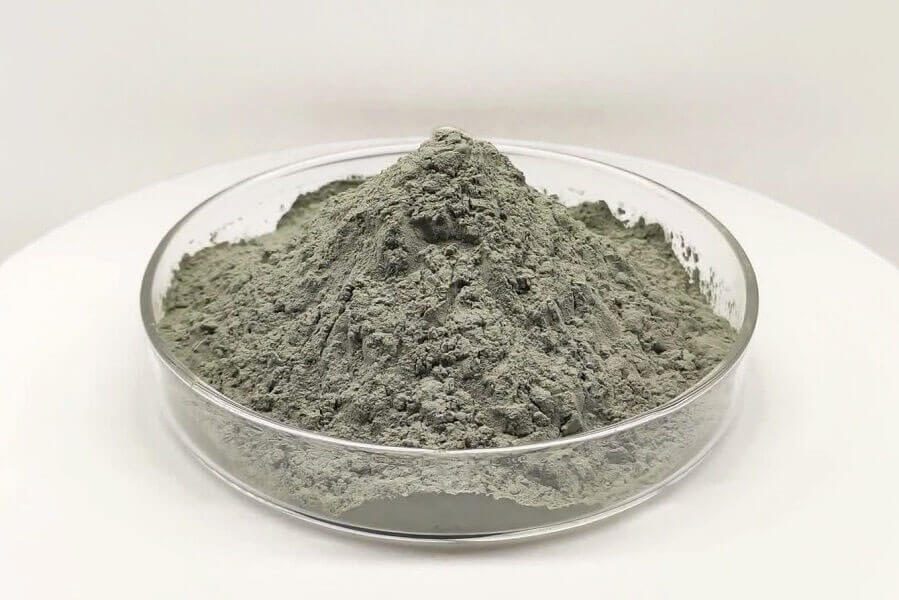
Green SiC is harder and more brittle than black SiC, producing sharper fractures. This makes it ideal for stock removal and shaping silicon before the final precision polish. It is used in free abrasive slurry form (loose grains mixed with a carrier fluid) in lapping processes.
2. Typical Grit Sizes Used
The process uses a progression of increasingly finer grits. Green SiC is used in the coarser steps:
Very Rough Lapping (Initial Flatting): F220 (~ 63 µm) to F500 (~ 20 µm). This removes saw marks and establishes basic flatness.
Intermediate Lapping: F800 (~ 12 µm) to F1200 (~ 3 µm). This further refines the surface, removing damage from the previous step and reducing subsurface damage depth.
Important: The transition from “lapping” to “polishing” is defined by the removal of subsurface damage. After the finest green SiC step, the surface is matte and scratched, but much flatter.
3. The Final Polishing Stage (What Comes After SiC)
Green SiC is not used for the final mirror finish. Its hardness would create unacceptable subsurface damage and surface roughness for semiconductor or optical applications.
The final polishing uses a colloidal silica slurry with extremely fine abrasive particles (in the range of 0.02 µm to 0.1 µm, or 20-100 nanometers).
This slurry, combined with a soft porous polyurethane pad, creates a chemical-mechanical polishing (CMP) action that removes material at the atomic level, resulting in a scratch-free, epitaxy-ready mirror surface.
Process Summary Table
| Stage | Primary Goal | Typical Abrasive | Grit Size (µm) | Surface Result |
|---|---|---|---|---|
| 1. Rough Lapping | Remove saw marks, establish flatness | Green Silicon Carbide | F220 – F500 (63 – 20 µm) | Opaque, heavily scratched |
| 2. Fine Lapping | Reduce subsurface damage, improve finish | Green Silicon Carbide | F800 – F1200 (12 – 3 µm) | Uniform matte finish |
| 3. Polishing | Remove all damage, achieve optical finish | Aluminum Oxide or Cerium Oxide | ~1 µm and below | Pre-polish, semi-shiny |
| 4. Final Polish / CMP | Atomic-level smoothness, epi-ready | Colloidal Silica | 0.02 – 0.1 µm | Perfect mirror finish |
Key Considerations for Selection
Subsurface Damage (SSD): Each coarser grit induces cracks beneath the surface. The next finer grit must remove material to a depth greater than the SSD layer from the previous step. This dictates the progression sequence.
Wafer Specification: The starting condition (wire-sawn, ground) and the final application (solar cell, IC wafer, MEMS) determine how many steps and which grits are necessary.
Consistency: For industrial production, tightly graded micron-sized powders (e.g., W7, W10, W14 which correspond to ~7µm, 10µm, 14µm) are often used instead of loose FEPA grit designations for better control.
Conclusion
To directly answer your question: Green silicon carbide in sizes ranging from ~60 µm (F220) down to ~3 µm (F1200) is used in the lapping stages to prepare single-crystal silicon. However, the final mirror polish absolutely requires a switch to a much finer, softer abrasive like colloidal silica in a CMP process. The exact starting and ending grit size for the green SiC steps depends on the initial wafer condition and the required final quality.