
What is “Chip Blasting”?
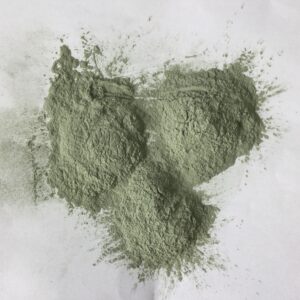
Why Green Silicon Carbide?
Extreme Hardness (9.5 on Mohs scale): Second only to diamond and boron nitride. It cuts very quickly and efficiently. Sharp, Friable Grains: The grains fracture to constantly present new, sharp edges, maintaining cutting performance. This is key for a consistent finish. “Green” Color: This denotes a high-purity (over 99% SiC) abrasive. It contains fewer metallic impurities than black SiC, making it ideal for applications where contamination (like iron staining) must be avoided, such as on titanium, certain alloys, or in semiconductor components.
The Two-Stage Process: 320 Mesh followed by 1200 Mesh
1. First Stage: 320 Mesh Green SiC
Grit Size: ~ 40-50 microns average particle size. It is a fine grit for abrasive blasting. Purpose: Initial Cleaning & Deburring: Removes light oxidation, scale, and small burrs left from machining. Creating a Uniform Anchor Profile: For coating adhesion, it creates a fine, even surface roughness (a “peak-to-valley” profile). Removing Previous Finishes: Can strip very thin coatings or paints without causing deep subsurface damage to the base material. Blending: Smooths out minor surface imperfections and begins the process of creating a uniform matte finish.
Resulting Surface: A smooth, matte, satin-like finish. To the naked eye, it will look uniformly dull, but under magnification, it will show a fine, peaked texture.
2. Second Stage: 1200 Mesh Green SiC
Grit Size: ~ 10-15 microns average particle size. This is an ultra-fine grit, almost a polishing compound. Purpose: Final Polishing/Refining: Its primary job is to “knock down” the microscopic peaks created by the 320-grit blasting. It doesn’t remove much material. Reducing Surface Roughness (Ra value): It creates a much smoother surface while maintaining the matte, non-reflective character and coating adhesion properties. Stress Relieving: The fine, peening action can induce beneficial compressive stresses on the surface, which can improve fatigue life. Cosmetic Finishing: Achieves a very consistent, premium matte finish that is pleasant to the touch (no “grittiness”).
Resulting Surface: An extremely fine, uniform matte finish. It will feel smooth to the finger. It is not a mirror polish, but rather a high-quality, low-Ra matte surface.
Typical Applications for This Two-Step Process
Aerospace & Turbine Components: Blades, vanes, and compressor parts where surface finish affects airflow and fatigue resistance. Medical Implants: Titanium or cobalt-chrome alloy implants (knees, hips) require a specific matte finish for both biocompatibility and to ensure bone adhesion/osseointegration. Semiconductor & Vacuum Chamber Parts: Cleaning and preparing surfaces without contaminating them with iron or other impurities. High-End Automotive (e.g., F1): Finishing of lightweight alloy components, pistons, and valves. Tool & Die Making: Creating a uniform matte finish on precision molds and dies to aid in material release and hide fine handling marks. Critical Welding Preparation: Creating an ultra-clean, contaminant-free surface with the ideal profile for high-integrity welds (e.g., in nuclear or pressure vessel applications).
Important Process Parameters
Blasting Pressure: Much lower than typical sandblasting (often 20-80 PSI). Abrasive Delivery System: A dedicated, oil- and moisture-free system is mandatory, especially for 1200-mesh, as fine abrasives easily clog. A suck-through (induction) cabinet is common. Media Reuse: Green SiC is expensive. 320-mesh can often be recycled. 1200-mesh is frequently used once or a limited number of times due to its tendency to break down.